A balcony in Warsaw or Poznań faces winter conditions that many plant labels do not account for. Container soil freezes faster than garden soil — there is no insulating ground mass — and winter winds accelerate moisture loss from both leaves and pots. What survives in a sheltered garden may not survive on an exposed fourth-floor balcony.
This guide covers plant groups with documented tolerance for those conditions. The focus is on species commonly available in Polish garden centres, listed at relevant hardiness ratings.

Cold-tolerant balcony plants maintain structure through wet autumn and winter conditions. Photo: Wikimedia Commons (CC BY-SA 2.0)
Why container hardiness differs from garden hardiness
Most hardiness ratings assume in-ground planting, where roots are protected by surrounding soil mass. In a container, the entire root zone is exposed to ambient air temperature. A plant rated "hardy to −15 °C" in the ground may suffer root damage at −8 °C in a thin plastic pot on a north-facing balcony.
Container material makes a measurable difference. Terracotta loses heat quickly but breathes well; it is also prone to frost cracking if the clay is porous. Dark plastic absorbs daytime heat but provides minimal insulation once temperatures drop. Double-walled polypropylene containers and fibreglass planters offer noticeably better root temperature stability. For winter use, wall thickness and material density matter more than aesthetics.
Practical cold protection for containers
- Wrap containers in horticultural fleece or burlap from November to February
- Raise pots off the balcony floor on wooden feet or pot feet to prevent waterlogging and frost transfer from concrete
- Group containers together — clustered pots lose less heat than isolated ones
- Move the most vulnerable containers to a sheltered corner or against an exterior wall
Dwarf conifers
Slow-growing dwarf conifers are a standard choice for winter balcony structure in Poland. The following are widely available in Polish nurseries and perform reliably in zone 6–7 conditions.
Picea glauca 'Conica' (Dwarf Alberta Spruce)
A compact, conical spruce that reaches 30–50 cm in a container over five years. Hardy to around −30 °C in the ground; in containers, rated reliably to −15 °C with basic insulation. Prefers a cool, moist location — south-facing positions with afternoon sun are problematic in summer. Dense, fine needles stay green through winter without significant browning if it is not positioned in strong wind.
Thuja occidentalis 'Danica'
A globe-shaped arborvitae that stays compact (30–40 cm) over several years in a container. Hardiness is rated to −30 °C in open ground. In containers on an exposed balcony, some needle browning may occur in a cold, dry winter, but the plant typically recovers in spring. Avoid positioning directly below a roof overhang where it will miss precipitation and dry out.
Juniperus horizontalis cultivars
Creeping junipers spread naturally over the edge of a container, creating horizontal structure that is unusual among winter-hardy options. 'Blue Chip' and 'Wiltonii' are both available in Polish garden centres. Tolerant of exposed positions and wind. Hardy to −35 °C in the ground; container performance is reliable to −15 °C without additional insulation.
Evergreen broadleaf shrubs
Several broadleaf shrubs maintain leaves through a Polish winter, though they require more attention than conifers in severe frost periods.
Ilex crenata (Japanese holly)
A small-leaved holly that resembles box (Buxus) in appearance but is not susceptible to box blight. Hardy to around −20 °C in the ground. In containers, protection below −10 °C is advisable. Available in compact forms ('Convexa', 'Stokes') suited to container growing. Does not require a second plant for berrying — individual plants produce black berries, though they are small and inconspicuous.
Euonymus fortunei cultivars
Wintercreeper euonymus tolerates a wide range of conditions, including partial shade and cold winds, making it practical for balconies that do not receive direct southern sun. 'Emerald Gaiety' (white-edged leaves) and 'Emerald 'n' Gold' (yellow-edged leaves) are standard cultivars in Polish retail. Hardy to approximately −20 °C in the ground; in containers, protect below −12 °C.
Hardy ornamental grasses
Carex (sedge) species offer texture and movement without the dormancy period of most grasses. Carex morrowii 'Ice Dance' and Carex oshimensis 'Evergold' maintain their foliage through winter in zones 6–7 and are available in most large Polish garden centres.
True ornamental grasses — Festuca glauca, Pennisetum alopecuroides — die back in winter but provide good structure through November with their dry seed heads. Their root systems tolerate container conditions well if the pot drains freely.
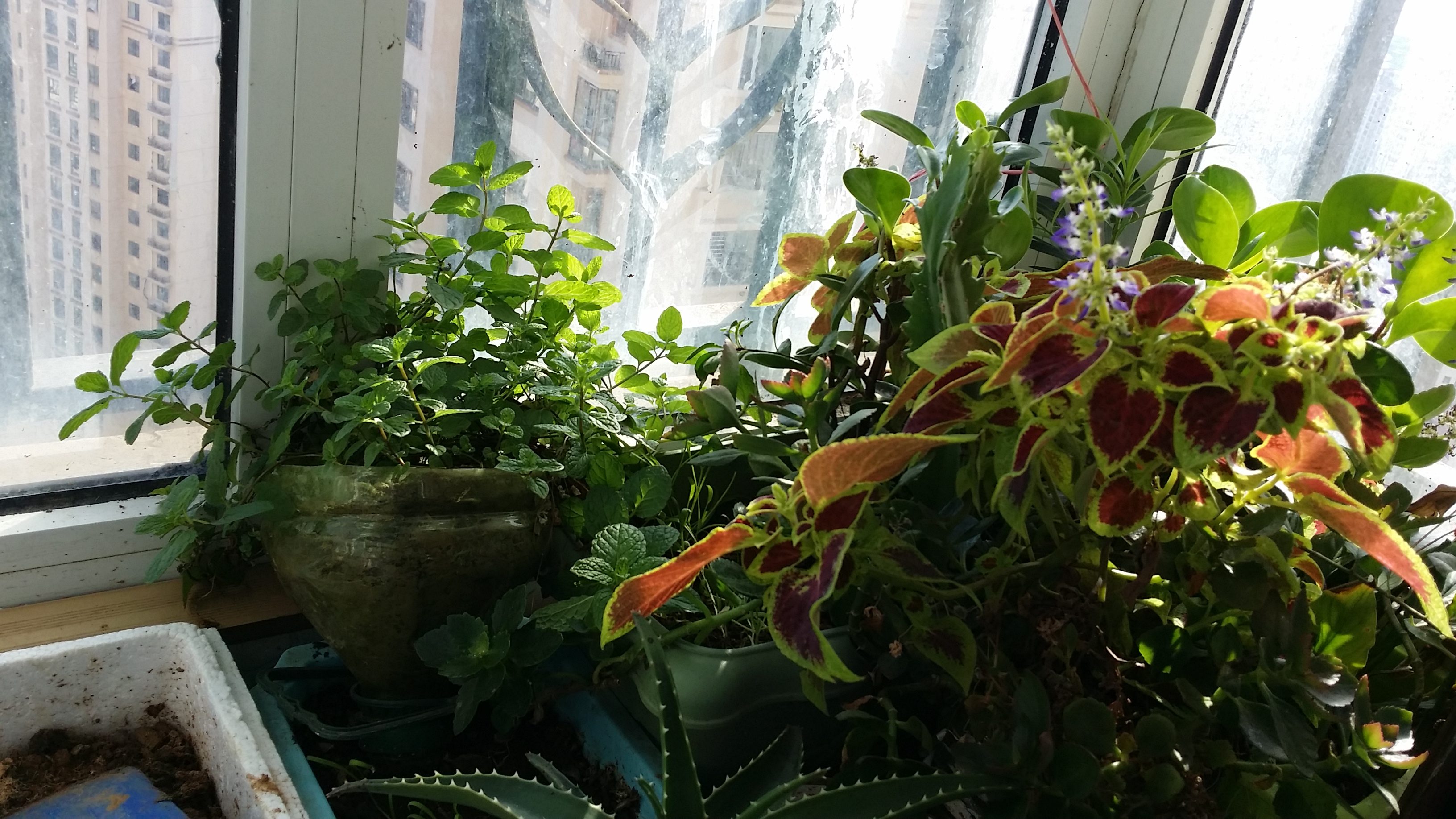
Container planting on an urban balcony — conditions above the third floor typically involve higher wind speeds and faster soil drying. Photo: Wikimedia Commons (CC BY 2.0)
What to avoid
Several popular balcony plants cannot survive a Polish winter outdoors, regardless of container insulation. These include Lavandula (lavender, hardy to around −15 °C in the ground but typically not in containers in sustained cold), Rosmarinus officinalis (rosemary, which browns and dies below −10 °C), and most Hebe species.
Bay laurel (Laurus nobilis) is frequently sold as a patio standard in Polish garden centres but requires winter storage indoors. It is a Mediterranean species that does not survive prolonged frost even in the ground in central Poland.
Annual cultivars — petunias, geraniums, impatiens — die at the first frost. They cannot be treated as winter plants regardless of how mild the preceding autumn has been.
Watering in winter
Evergreen plants in containers still transpire moisture through their leaves in winter, even when growth has stopped. During dry, cold periods — particularly when temperatures are just below 0 °C rather than deeply frozen — containers can dry out. Check soil moisture monthly in winter. Water sparingly on days when temperatures are above 0 °C so the water has time to penetrate before re-freezing.
Avoid watering when the soil is frozen solid, as the water will pool on the surface and then freeze, potentially causing frost heave that can dislodge root systems.
More articles
Continue reading

Container Choices for Small Balconies
How planter size, material, and drainage decisions affect plant health when space is limited.
May 28, 2026
Seasonal Porch Arrangements Across Poland's Climate
Layout approaches and plant selections that shift with the calendar.
May 20, 2026